Blog > The Grove in Sugar Grove: Approvals, the Advisory Vote and Water Questions
The Grove in Sugar Grove: Approvals, the Advisory Vote and Water Questions
by
The Grove in Sugar Grove: Approvals, the Advisory Vote and Water Questions
The agreements came first. The advisory vote came later. With homes now marketed for sale, the timeline and the water records deserve a closer look.
Information reviewed: October 27, 2026. Referendum context: April 2025.
Why did The Grove keep moving after voters backed reversal?
If voters wanted The Grove reversed, why are homes now being marketed for sale? Start with the order of events. Sugar Grove approved the development agreements in September 2024. Residents voted on an advisory question in April 2025, after those commitments were in place.
The village’s referendum fact sheet, prepared before the election with its attorney, explains that the vote expressed public opinion and did not have the force of law. It also warned that reversing approvals tied to the annexation agreement could expose the village to breach-of-contract liability.
That does not make the public’s opposition unimportant. It means the ballot was a request for officials to pursue lawful reversal, rather than a veto that canceled the approvals when the votes were counted.
What happened, and in what order?
September 10, 2024: The village approved the annexation agreement, annexation, planned development district, subdivision and TIF-related measures listed in its fact sheet. The recorded annexation agreement identifies September 10 as its effective date. Its owner and village signature acknowledgments are dated September 19 and September 24, respectively.
December 26, 2024: The village received the resident-submitted referendum petition, according to its public acknowledgment. The question asked whether the prior approval should be reversed using necessary and lawful measures.
January 2025: The village prepared the fact sheet describing the question’s nonbinding effect and the contractual risk of reversal. Those limits were documented before the election.
April 1, 2025: Voters supported the advisory request to reverse the project. The April 6 Daily Herald report describes the result and Stillwell’s stated intention to advocate for residents.
May 2025: Sue Stillwell’s term as village president began, according to the village’s official profile. The administration changed after the agreements and referendum, rather than before the original approval.
By August 2025: Crown’s publicity representative had announced construction on the first residential lots. That release is dated August 28.
September 2025 to October 2026: The village posted at-risk mass-grading materials in September 2025. On October 27, 2026, M/I’s community page lists “Now Selling.” These are later development milestones, not proof that the referendum itself authorized construction.
What could the vote and the new administration change?
The clearest documented limit is on what the referendum itself could do: it did not rescind the existing approvals. The village’s fact sheet described possible contract liability, not a finding that every legal option was impossible.
The annexation agreement includes a 20-year term and procedures addressing defaults, enforcement and other contingencies. Those provisions do not establish that a particular default occurred or that the village had a successful route to cancel the project. Whether amendments, enforcement or litigation could achieve a particular result depends on the facts and legal advice.
Stillwell’s reported promise to advocate for residents and listen to neighbors is not the same as a verified guarantee that she could reverse the development. A public Facebook campaign promise guaranteeing reversal has not been verified for this article.
There is a later documented example of scrutiny under the new administration: the September 2026 water-capacity packet includes Stillwell’s requests for updated calculations and EEI’s response. It does not establish that the original agreements were canceled. A complete account of the new board’s 2025 reversal efforts would require more meeting and legal records than have been verified here.
Where would The Grove’s water come from?
The village’s 2025 drinking-water report identifies groundwater as Sugar Grove’s supply. It lists deep sandstone wells and shallow sand-and-gravel wells. The water master plan identifies deep sandstone as the primary supply.
Section 7.1 of the annexation agreement allocates potable-water capacity and treatment from the village system up to nine population equivalents per gross acre. It also makes the owner responsible for a 750,000-gallon storage tank, a booster-pump/pressure-reducing installation and specified improvements. Those are agreement obligations, not confirmation that each improvement is complete.
Population equivalents are a planning measure of demand. The development-wide allocation should not be described as a measured water-use figure for an unnamed data center.
Is there enough supply for existing residents and new housing?
The most current capacity calculation reviewed here is EEI’s September 1, 2026 memo. It compares 2,400 gallons per minute of firm supply capacity with 2,381 gallons per minute of projected maximum-day demand for the developments evaluated, leaving a 19-gallon-per-minute margin. Firm capacity means meeting maximum-day demand with the largest well out of service.
The table includes the existing system’s 2022 demand, The Grove, Settlers Ridge areas 5 and 6, Brighton Ridge, a fire-training facility and an allowance for future residential development. These are estimates, not readings showing that every proposed home is occupied or that all future growth is approved.
EEI calls the evaluated capacity generally adequate and describes conservative demand assumptions. It also says the development inventory was not comprehensive, growth may be moving faster than earlier assumptions, and the village should consider an updated master plan and aquifer sustainability analysis. Both parts matter. The margin is small in that calculation, but it is not proof that taps are about to run dry.
The older April 2024 master plan assesses longer-term aquifer risks through modeled scenarios and recommends continued monitoring. Its regional supply assumptions and planning horizon are different from a development-specific capacity check. Adequate pumping capacity today does not settle groundwater sustainability for every future phase.
What about neighbors who use private wells?
A municipal customer and a neighbor with a private well do not necessarily draw water from the same aquifer or face the same operating conditions. Well depth, location, construction and the water-bearing formation matter.
The Illinois State Water Survey’s 2024 township study examines shallow groundwater and identifies sensitivity to drought and surface influences. Its monitoring program tracks local shallow sand-and-gravel and bedrock aquifers. Those sources support continued monitoring. They do not establish that The Grove has dried up a particular well.
The capacity packet includes an engineer’s explanation distinguishing the deep-aquifer modeling from local shallow wells. That is not a substitute for checking an individual neighbor’s well record and local measurements. This article has not verified a project-specific private-well impact assessment or documented a causal link between The Grove and a dry well or brown lawn. Those remain concerns to investigate, rather than established project effects.
What do we actually know about data-center water demand?
Crown’s construction announcement describes a major data center as under contract within Grove Park. That is the developer’s stated stage. This review has not confirmed the operator, a completed sale, an operating facility, its cooling design or an approved site-specific water-demand figure.
The 2026 capacity packet includes EEI correspondence discussing an earlier ISWS hypothetical high-demand data-center scenario. EEI says that scenario was not used as the master plan’s long-term basis and that the development’s water-use limitations made it inapplicable for those planning purposes. That explanation should be attributed to EEI. The underlying data-center study has not been independently reviewed here.
A hypothetical scenario can help ask what might happen under stated assumptions. It does not tell us what an actual future operator will consume. The useful next questions are the proposed average and peak demand, source of water, cooling method, enforceable allocation, monitoring and how the plan protects existing customers and neighboring wells.
What does M/I’s sales page say now?
On October 27, 2026, M/I’s official community page lists The Grove’s community status as “Now Selling.” It markets single-family homes in Sugar Grove.
The page also uses appointment-waitlist and early-update language. I would confirm the specific home or homesite, appointment arrangements and purchase timing directly rather than interpret that status as proof that a finished home is ready for immediate occupancy.
A sales launch and a completed neighborhood are different milestones. If you’re considering a move, the details for your particular home matter more than the broad community label.
Who is developing The Grove, and where does M/I fit?
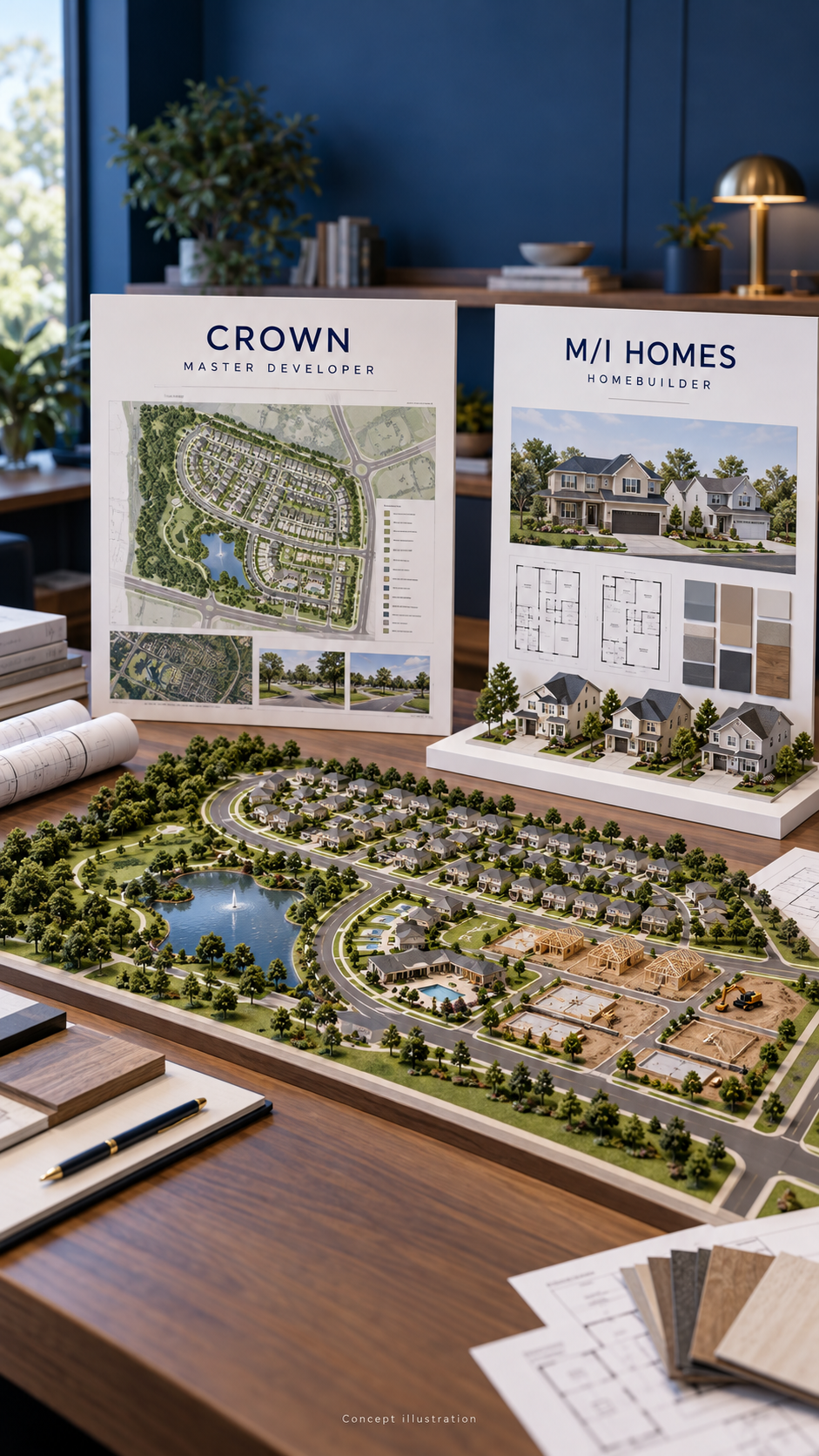
Crown Community Development is the master developer. M/I Homes is a homebuilder within The Grove. The names refer to different roles, not two names for one company.
Crown’s construction announcement describes a roughly 760-acre master-planned community around I-88 and Illinois 47. It identifies Area 1 along Merrill Road as the first residential phase, with 214 single-family homes planned.
That announcement is background on the phase and development structure. It is not a new October 27 construction-start announcement, and its earlier projections should not be treated as a current delivery promise.
For a buyer, it is useful to ask which company is responsible for the home, which improvements belong to the broader development, and what documentation supports the expected timing of each.
What about the Town Center, parks and other amenities?
M/I describes a proposed Town Center and future parks, trails and recreation features. Crown’s announcement also outlines a broader mix of homes, open space and other development.
Those descriptions show the vision for The Grove. They should not be read as an inventory of amenities already delivered. Before choosing a home because of a particular feature, ask about its phase, current status and expected delivery.
The same care applies to pricing, available lots and move-in dates. Those can change and need to be checked for the actual home you are considering.
How should residents and buyers read the disagreement?
The referendum result is meaningful historical context. It does not tell us what every resident thinks now, or how people feel about an individual family buying a home there.
It is possible to ask serious questions about development decisions while keeping the conversation fair to neighbors and future homeowners. The most useful questions are specific: What was approved? What is being built now? Which promised features remain future plans?
If you’re weighing a home at The Grove, I would start with those questions and the current documents. If you’re following the broader community change, the village’s records are a better starting point than treating an older headline as the latest project status.
Questions you may be asking
Did the referendum cancel The Grove’s approvals?
No. The April 2025 vote was advisory and did not itself rescind the September 2024 approvals. The village’s pre-election fact sheet also warned of possible breach-of-contract liability from reversal.
Were the agreements approved before the referendum?
Yes. The village approved the agreements and related measures in September 2024. The referendum petition was received December 26, 2024, and the vote occurred April 1, 2025.
Does the latest capacity memo say the village has no water left?
No. EEI’s September 1, 2026 calculation found a 19-gallon-per-minute firm-capacity margin for the developments evaluated. It called capacity generally adequate under its assumptions, noted an incomplete development inventory and suggested updated planning.
Has The Grove been shown to dry up private wells?
A project-specific causal link to a dry private well or brown lawn has not been verified here. Individual well characteristics, measurements and groundwater conditions need separate review.
Is the future data center’s actual water use known?
An operator, cooling design and approved site-specific demand figure have not been confirmed in this review. Crown describes a data center as under contract, which does not establish that it is operating.
Is M/I the master developer?
Crown Community Development is the master developer. M/I Homes is a homebuilder within The Grove, and its page lists the community as Now Selling as checked October 27, 2026.
What would you want to know before buying?
What would you want answered next about The Grove: the approval timeline, water planning or the remaining development phases? If you’re comparing Sugar Grove and Fox Valley homes, let’s talk through the details that matter for your move.
Call Brian at 630-465-7413Sources: village development records; referendum fact sheet; recorded annexation agreement; September 2026 capacity memo and correspondence; April 2024 water master plan; 2025 drinking-water report; ISWS township study abstract; ISWS monitoring program; M/I Homes; Crown; construction announcement; Daily Herald referendum report. Reviewed October 27, 2026. Estimates, future plans and actual operating conditions are distinct.